Accepting Variance Gives You Equanimity
Recognizing random variation can help separate the quality of a decision from its immediate result. Galef uses a pitcher’s response to good and bad streaks to illustrate a steadier way of evaluating performance.
THE IDEA
Accepting Variance Gives You Equanimity
I don’t usually pay much attention to sports, but my interest was piqued when I saw an interview with Trevor Bauer, a pitcher for the Cleveland Indians. Bauer had recently been pitching well against the Houston Astros, with a 6–0 streak, and when an interviewer asked him the secret to his success, Bauer replied, “Random variation. It won’t continue. At some point, it will break.”18
The answer made me grin with surprise. Almost everyone, when asked to explain their success, gives a causal explanation like, “My extra practice is finally starting to pay off” or “It’s because I believed in myself.” How often do you hear someone chalk their own success up to “random variation”?
Bauer was right—his streak did end. Soon after, another interviewer was grilling him about the unusually high number of home runs that players had been scoring against him recently. Bauer replied, “I know the results will match my stuff at some point . . . I can’t keep having the home run per fly ball rate that is absurdly high right now, and that’s how most of my runs are being scored right now.”19
A pitcher’s “home run per fly ball” rate fluctuates a lot over short periods of time, which means that the statistic is mostly capturing random variance and not skill. Bauer’s point was that it therefore didn’t make sense to get too worried about his current home run per fly ball rate being unusually high. Once again, he was right—by the very next season, Bauer had one of the lowest home run per fly ball rates of anyone in the game.20
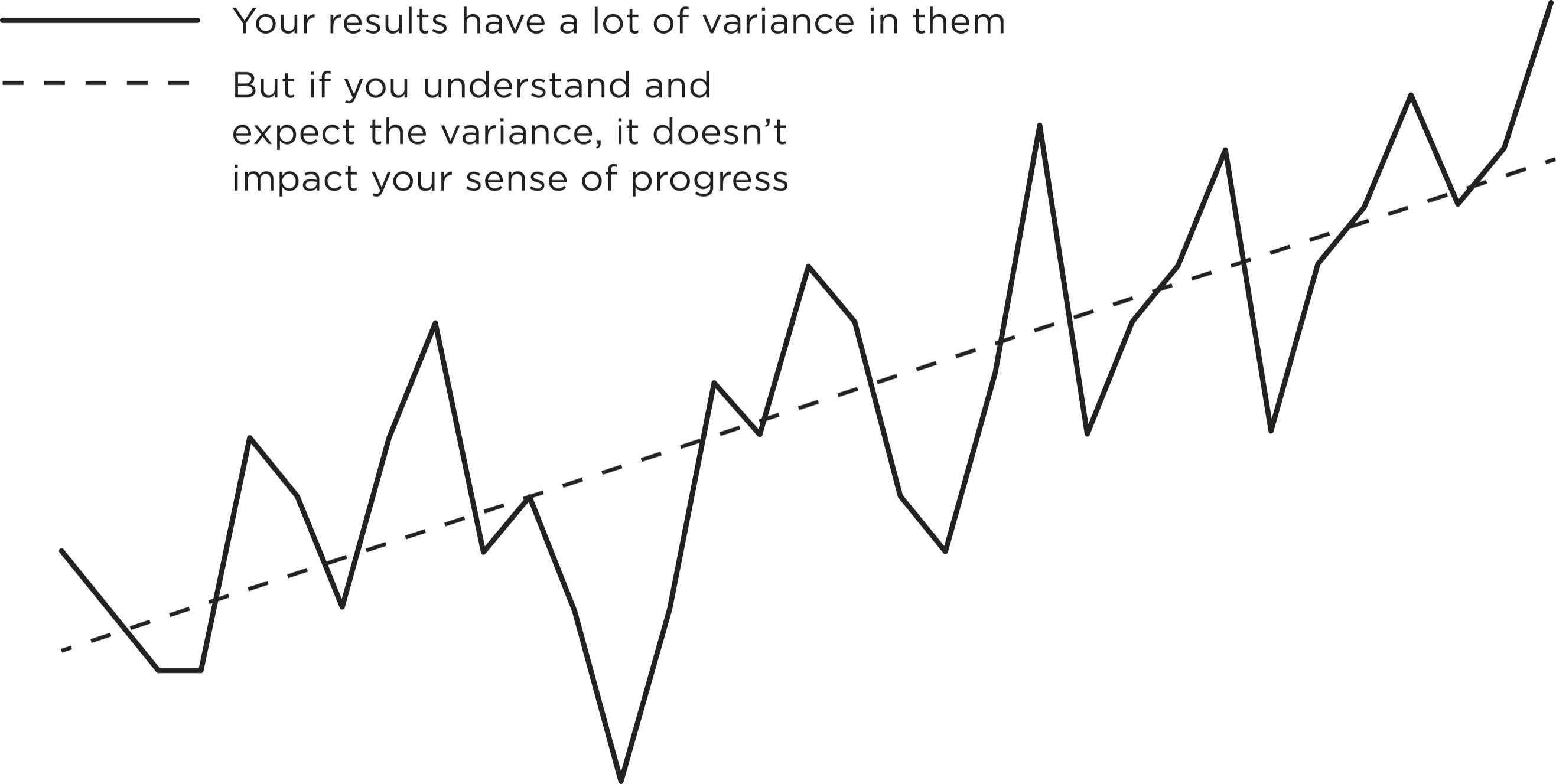
THE PSYCHOLOGICAL EFFECT OF EXPECTING VARIANCE *
It might be motivating to believe with absolute certainty that you’re going to win, but it’s not realistic—there’s always some element of chance involved, in any endeavor. Over time, your outcomes will fluctuate; some of your bets will turn out well, and many will turn out poorly.
With repeated positive-expected-value decisions, individual outcomes may become less important to the overall record. That does not guarantee recovery from every loss: the size of the risks and the ability to keep going matter too. Expecting variation can nevertheless make each result less emotionally consuming and help you attend to the quality of your choices.
The goal isn’t to attribute everything to luck. It’s to do your best to mentally separate out the role that luck plays in your results from the role that your decision-making plays, and to judge yourself based on the latter. Here’s an example of Bauer doing a postmortem of his pitching in one game:
Not a great pitch, but I defend the logic behind throwing it. Walked [Jason] Castro, not a good idea. Then, tried to get [Brian] Dozier on a fastball away, came back, good pitch, but he hit it.21
Notice how he gives himself credit, then blame, then credit—all based on the quality of his pitching choices, independently of how they turned out.
When to use it
A poker player accepts that bad beats are part of the game and focuses on making mathematically sound decisions.
A business leader avoids overreacting to quarterly earnings blips and sticks to a long-term strategy with positive expected value.
An athlete uses post-game analysis to separate quality of performance from luck, maintaining equanimity through streaks.
An investor reviews performance over an appropriate time horizon, distinguishing ordinary volatility from evidence that the assumptions behind the investment have changed.
FROM THEORY TO EVERYDAY LIFE
In practice
Trevor Bauer's Streak
Galef describes Trevor Bauer attributing a 6–0 streak to random variation. When his home-run-per-fly-ball rate later rose unusually high, he expected it to fall again; it did in the following season. The story illustrates his willingness to consider luck in both good and bad results.
Postmortem of a Pitch
Bauer evaluated a game by judging the quality of his decisions independent of outcomes: 'Not a great pitch, but I defend the logic behind throwing it. Walked Castro, not a good idea. Then, tried to get Dozier on a fastball away, came back, good pitch, but he hit it.'
A MOMENT TO REFLECT
Put it to work.
Think of a recent success or failure in your life. To what extent was it due to your decisions versus random variation?
How can you train yourself to evaluate decisions based on process rather than outcomes?
In what areas of your life do you tend to overreact to short-term fluctuations?
CONTINUE THE CONVERSATION
Source texts
- The Scout Mindset (Julia Galef)