A Renewable Stock Constrained by a Nonrenewable Resource
The model links an extracted resource stock with capital investment and depreciation. The resource has no replenishment inflow, and declining yield constrains extraction and profit.
THE IDEA
A Renewable Stock Constrained by a Nonrenewable Resource
The resource stock below has an extraction outflow and no regeneration inflow. The stock renewed through investment is capital. Applications to fish or forests would require an additional model of resource replenishment.
Stock: resource(t) = resource(t – dt) – (extraction × dt)
Initial stock values: resource = 1000 … for Figures 38, 40, and 41; 1000, 2000, and 4000 … for three comparative model runs in Figure 39.
Outflow: extraction = capital × yield per unit capital
t = years
dt = 1 year
Run time = 100 years
Stock: capital(t) = capital(t – dt) + (investment – depreciation) × dt
Initial stock values: capital = 5
Inflow: investment = minimum of profit or growth goal
Outflow: depreciation = capital / capital lifetime
Converters: capital lifetime = 20 years
profit = (price × extraction) – (capital × 10%)
growth goal = capital × 10% … for Figures 30–40; capital × 6%, 8%, 10%, and 12% … for four comparative model runs in Figure 40.
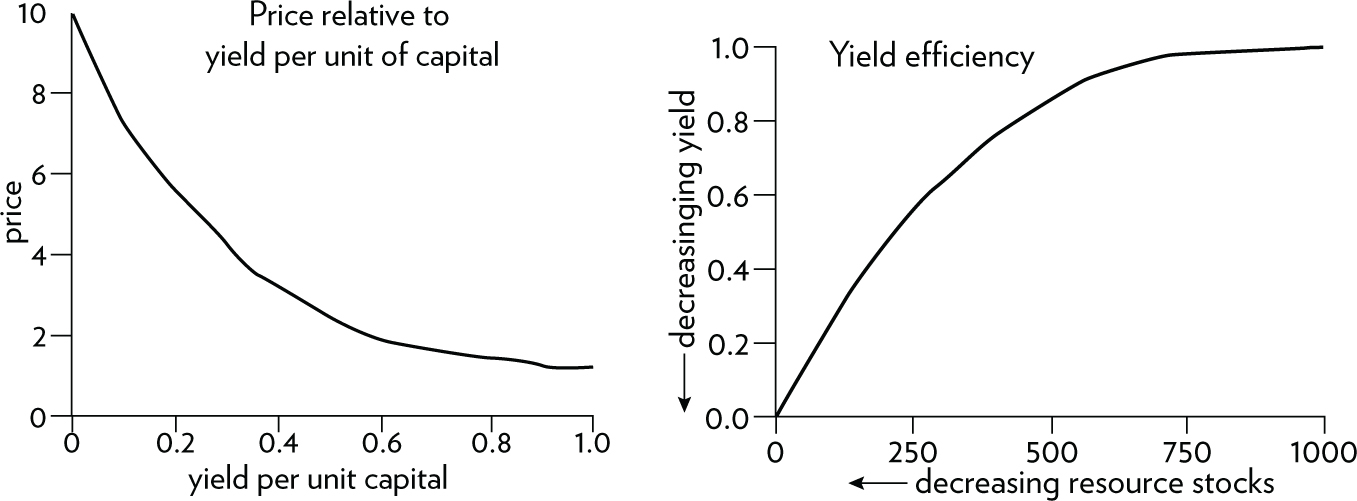
price = 3 … for Figures 38, 39, and 40; for Figure 41, price starts at 1.2 when yield per unit capital is high and rises to 10 as yield per unit capital falls, as shown in graph
yield per unit capital starts at 1 when resource stock is high and falls to 0 as the resource stock declines, as shown in graph
When to use it
Comparing resource depletion under different extraction and investment policies.
Evaluating a capital-investment model constrained by a nonrenewable resource.
Identifying which replenishment assumptions must be added before applying a depletion model to a renewable resource.
Teaching system dynamics and feedback loops in resource economics.
FROM THEORY TO EVERYDAY LIFE
In practice
Adapting the Model to a Fishery
Fishing boats could represent the capital stock, but a fishery model would also need a replenishment inflow for the fish population. The supplied equations do not include it, so they cannot on their own establish sustainable harvest levels.
Adapting the Model to Forestry
Logging equipment could represent capital. To model a renewable forest, add assumptions about tree growth and regeneration as well as extraction. Profit and investment alone do not determine whether the forest is sustained.
A MOMENT TO REFLECT
Put it to work.
How does the growth goal affect the long-term sustainability of the resource?
What happens if the price of the resource increases as it becomes scarcer?
How could you modify the model to include resource regeneration?
CONTINUE THE CONVERSATION
Source texts
- Thinking in Systems A Primer